
Your Guide to Pool Light Replacement
You’ve changed countless light bulbs, so how hard could it possibly be to replace one in your pool? Well, the answer might surprise you. Most pool lights are underwater, posing an unusual challenge and potential safety hazard to the average homeowner. Stick with us as we discuss the considerations to keep in mind when it comes to pool light replacement.
What’s the average lifespan of an inground pool light?
The type of bulbs in your swimming pool has a major impact on lifespan. Here’s a breakdown of the most common styles of bulbs in in-ground pool lighting fixtures:
Halogen bulbs
Back in the 1990s and early 2000s, halogen bulbs were standard in most pools. However, they generated a lot of heat and tended to burn out relatively quickly. If you’re still using halogen bulbs in your pool, you can expect to replace them every one to three years, or after 1,000 to 2,000 hours in use.
Incandescent bulbs
Incandescent pool light bulbs operate for an even shorter period of time than halogen styles, often requiring replacement after a year or two, or less than 1,500 hours. That’s because they’re sensitive to voltage fluctuations and contain filaments that are prone to breakage.
LED bulbs
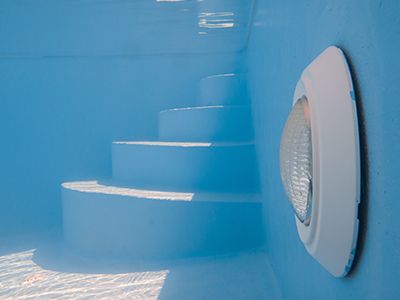
Fortunately, most pools now utilize LED bulbs, which can last 20 years or more, or over 50,000 hours, in a properly sealed fixture. LED models generate very little heat, are better equipped to withstand power cycling, and don’t contain fragile filaments. In fact, when LEDs fail prematurely, it’s usually due to underlying electrical issues or faulty installation.
Additionally, LED bulbs, like Intellibrite and Globrite from Pentair, are compatible with advanced pool automation systems, allowing you to sync color lights for the ultimate swimming experience.
Related: Inground Pool Lighting to Transform Your Backyard
Can you do a pool light replacement yourself?
In some cases, handy homeowners can perform a pool light replacement without professional help. Here are a few questions to ask yourself:
Do you have to drain the pool to replace the light?
Most modern pool lighting systems are designed to be serviced when full. Instead of draining the pool, you remove the light and waterproof housing from the pool to switch a bulb. However, there are a few exceptions, including conduit changes or other repairs that need to be made before installing a new bulb.
Do you need an electrician to change a pool light?
Hiring an electrician for a simple light bulb replacement is overkill, but more extensive work may require specialized help. For voltage conversions, transformer replacements, equipment upgrades, and grounding adjustments, you’ll need a qualified electrician to ensure the job is up to code.
How much should a pool light replacement cost?
The price of DIY pool light replacement depends on the type of bulbs in your pool. Halogen and incandescent bulbs typically cost $20 to $60 each. New LED bulbs may cost $50 to $150 on their own, or $300+ with fresh housing. Outsourcing the job will cost you. You can expect to pay $150 to $300 for a simple bulb replacement.
Related: Pool Maintenance 101: How To Care for Your Pool
When to call the pros for your pool light replacement
While it can be safe to perform your own pool light replacement, there are plenty of good reasons to call in professional reinforcements. Here are a few situations when it’s better to rely on a trusted pool technician for bulb changes:
Water inside the fixture
Foggy lenses, visible water droplets inside the housing, and the presence of rust or corrosion all signal that the barrier between water and the electrical system has been compromised. If you see a cracked lens or suspect that your seals have failed, call in the experts right away. You may need to replace the entire lighting fixture, not just the bulb.
Frequent GFCI tripping
Ground fault circuit interrupters are critical safety components of any electrical system in close proximity to water or humidity. These systems work by monitoring energy supply around the clock.
When they detect an unusual fluctuation, they shut down instantly to prevent electrical shock. If GCFI outlets are regularly losing power, you may have a more serious problem on your hands than a dead light bulb. These could be:
- Moisture intrusion
- Insulation breakdown
- Internal short in the lighting fixture
- Transformer or junction box failure
Visible damage or complete failure
Professional replacement may also be unavoidable when your pool or spa light stops working altogether or has obvious visible damage. Electrical equipment is not something to troubleshoot unless you’re a skilled electrician, and this is particularly true of submersible components.
But even with deck-mounted lighting and other outdoor options, it’s better to play it safe than attempt to repair damaged or faulty products yourself. When your luminaire stops responding to the switch or controller, despite power and a working GCFI, it’s time to call in the experts.
Buzzing or humming sounds
If you hear unusual sounds coming from your pool’s lighting fixtures, you need to take action immediately. This is no longer a simple bulb problem, but a potentially fatal equipment failure. Those noises could indicate loose internal connections, electrical arcing, faulty ballasts, or improper voltage.
Uncertainty about the wiring
Pool light replacement should never be an exploratory process. In order to perform this task safely, you should already know your system from top to bottom, including the voltage, where to find the transformer or junction box, and grounding and bonding specifications. If your pool lighting runs on solar, you’ll need a more specialized knowledge of your system.
Related: 5 Reasons to Leave Pool Equipment Repair to the Professionals
GPS Pools has everything you need for maintenance and repair for your pool!
Still a little uncomfortable with the idea of performing your own pool light replacement? The team at GPS Pools is here to help, whether you need a simple bulb swap or a complete system upgrade! Reach out today to learn more!